Search
Research
Immunogenicity and Safety of a 2 + 1 DTPa Priming Schedule in Australian Infants and the Impact of Maternally Derived Antibodies on Pertussis Antibody Responses up to 4 Years of AgeWe assessed the impact of maternally derived pertussis antibodies on infant responses to a 2 + 1 vaccine schedule (6 weeks, 12 weeks, and 12 months). Infants with baseline antibodies showed lower IgG responses following the primary vaccination series, but this did not impair booster responses at 4 years of age.
News & Events
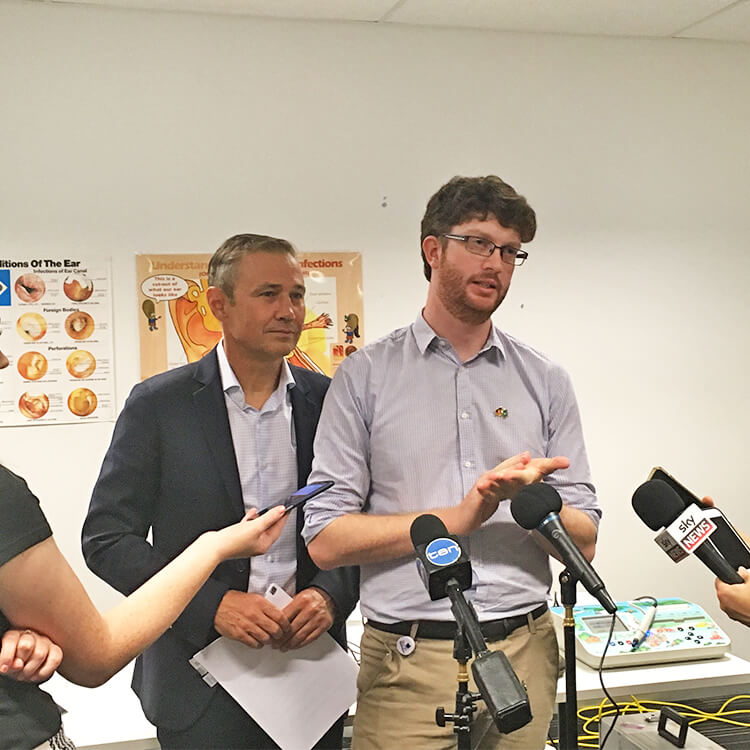
Six-minute Strep A tests dramatically cut wait time in remote settingsChildren at risk of potentially life-threatening Strep A infections no longer have to wait five days for timely treatment, thanks to a The Kids Research Institute Australia study conducted in the remote Kimberley region of Western Australia.
Find out more about the scholarship opportunities at the Wesfarmers Centre, including Training Scholarships and Higher Degree by Research Scholarships.
News & Events
$3.4 million funding boost supercharges fight against RSVNational research led by the Wesfarmers Centre of Vaccines and Infectious Diseases, based at The Kids Research Institute Australia, has secured more than $3.4 million to assess the epidemiology of respiratory syncytial virus (RSV) throughout the country and optimise Australia’s immunisation strategy.
News & Events
Spectacular sunset launch for the Missing Piece Story BooksWesfarmers Centre of Vaccines and Infectious Diseases researchers Dr Janessa Pickering and Dr August Mikucki travelled to Broome last week for the official launch of the long-awaited Missing Piece story books.
Research
Healthy skin for children and young people with skin of colour starts with clinician knowledge and recognition: a narrative reviewSkin conditions most frequently encountered in paediatric practice include infections, infestations, atopic dermatitis, and acne. Skin of colour refers to skin with increased melanin and darker pigmentation, and reflects global racial and ethnic diversity. Managing skin conditions in skin of colour requires health equity nuance, which is rarely explicitly taught.
Research
Serological Responses to Target Streptococcus pyogenes Vaccine Antigens in Patients With Proven Invasive β-Hemolytic Streptococcal InfectionsRising incidence of invasive β-hemolytic streptococcal (iBHS) infections has prompted consideration of vaccination as a preventative strategy for at-risk populations. The benefits of a vaccine targeting Lancefield group A (Streptococcus pyogenes; Strep A) would increase if cross-species immunity against Lancefield groups C/G (Streptococcus dysgalactiae subspecies equisimilis; SDSE) and B (Streptococcus agalactiae; GBS) was demonstrated.
Research
Invasive group B streptococcal infections in Western Australia, 2000–2018Neonatal and puerperal sepsis are major manifestations of invasive group B streptococcal (Streptococcus agalactiae; iGBS) infections. International data indicate the importance of iGBS infections among non-pregnant adults.
Research
Acceptability and Implementation Challenges of Benzathine Penicillin G Secondary Prophylaxis for Rheumatic Heart Disease in Ethiopia: A Qualitative StudyMonthly intramuscular injections of benzathine penicillin G (BPG) remain the cornerstone of secondary prophylaxis for acute rheumatic fever and rheumatic heart disease (RHD). The barriers to successful delivery of BPG may be patient- or service-delivery-dependent.
Research
Safety, tolerability and pharmacokinetics of subcutaneous meropenem as an alternative to intravenous administrationSubcutaneous delivery of antibiotics is a practical alternative to IV administration. Meropenem is commonly used to treat infections caused by resistant Gram-negative organisms.